
Search funds have become one of the most popular paths to entrepreneurship through acquisition (ETA). More entrepreneurs are raising search capital, more investors are backing searchers, and more business schools are offering ETA-focused coursework than ever before.
Yet Stanford Graduate School of Business’s 2026 Search Fund Study reveals an important reality: acquiring a business has become significantly more difficult. They report that the journey from launching a search to closing an acquisition is no longer as straightforward as it once was.
The main challenge no longer is raising capital, it is finding and successfully closing the right deal.
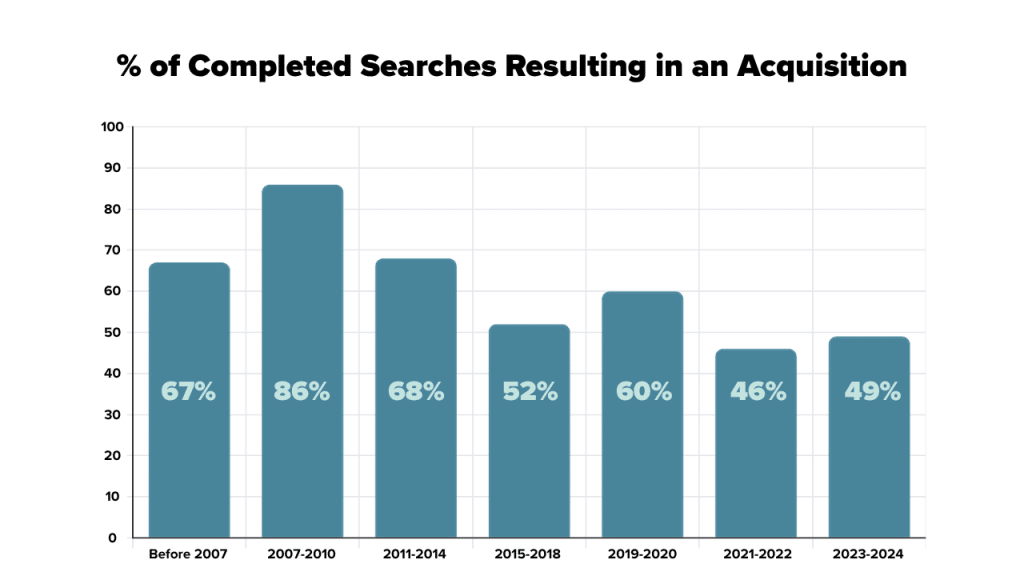
Let’s Quantify How Buying a Business is Getting Harder
The headline statistic from Stanford’s study is difficult to ignore. Searchers who launched funds between 2007 and 2010 acquired companies at an 86% rate. For funds launched between 2021 and 2024, that figure has fallen to approximately 48%, meaning less than half of recent searchers ultimately acquired a business. Sam Scharich, Buy-Side Managing Director commented, “I believe the 2007–2010 cohort benefited from searching during a rare transition point in the market. Severe uncertainty initially froze transaction activity, but it also forced many owners to reconsider succession, personal risk and how long they wanted to continue operating their businesses. As conditions began to stabilize, those newly motivated sellers encountered a smaller pool of buyers prepared and able to act. Searchers operating through that transition likely benefited from more pragmatic sellers, less competition and improving access to capital before the broader market fully recovered.”
At the same time, search funds have become increasingly popular in the last few years. New search fund launches reached record levels in recent years, and Stanford identified 190 new international search funds launched in 2024-2025 alone. More buyers are entering the market, creating greater competition for the same pool of high-quality acquisition opportunities.
This growing trend translates to increased competition, which is also affecting valuations. Stanford reported that the median purchase price for acquired companies reached $16 million in 2024-2025, the second-highest level ever recorded. By comparison, the 2008-2009 cohort, which achieved some of the strongest acquisition outcomes in the study’s history, purchased businesses for a median of $6.5 million.
Stanford’s study reflects what we are seeing at Calder Capital: more buyers are pursuing a limited supply of attractive companies, making acquisitions both harder to secure and often more expensive. However, increased competition is only part of the story. Stanford also found that acquisition success is associated with factors such as searcher experience, partnership structure, and the ability to generate momentum early in the search process. Calder’s experience suggests that proprietary, off-market opportunities have become increasingly valuable. As more buyers compete for the same marketed businesses, searchers who identify companies before they enter a broad sale process may face less competition and have a greater opportunity to build direct relationships with owners.
For many buyers, the challenge is not simply evaluating businesses: it is building enough qualified deal flow in the first place. Researching targets, identifying decision-makers, prospecting, calling owners, following up consistently, and maintaining a pipeline requires significant time and resources. That is where Calder Capital’s buy-side process is designed to add value. Rather than waiting for opportunities to reach the market, our team proactively researches acquisition targets, conducts direct outreach to owners, leverages our network, and qualifies opportunities before introducing them to clients. In a market where competition for quality businesses continues to increase, we believe a disciplined off-market sourcing strategy can help buyers access opportunities earlier, generate momentum faster, and expand the universe of potential acquisition targets.
Why Deals Fall Apart, Statistically
When pursuing an acquisition, finding a business is only the beginning.
According to Stanford, searchers who completed acquisitions in 2024-2025 signed an average of 2.5 letters of intent before successfully closing one transaction.
The most common reason why deals fail, they found, is because of discoveries made during due diligence. Nearly 79% of respondents cited diligence findings as a primary reason an LOI failed. Valuation disagreements were identified by 45% of respondents, while 40% pointed to a lack of investor support. For this reason, many experienced buyers pursue multiple opportunities simultaneously rather than relying on a single transaction to reach the finish line. At Calder Capital, it is not uncommon for clients to have multiple signed LOIs at the same time. Given how frequently deals fall apart during diligence, maintaining a pipeline of qualified opportunities can help buyers preserve momentum and improve their chances of completing a successful acquisition.
These findings highlight an important reality about today’s acquisition environment. A business may appear attractive during early conversations, only for customer concentration issues, margin concerns, financial reporting inconsistencies, working capital needs, or other risks to emerge later in the process.
In other words, signing an LOI is no longer the biggest hurdle for a buyer. Confirming the quality of the opportunity through diligence is. Many of the issues uncovered during diligence are significant enough to change a buyer’s valuation, financing assumptions, or appetite for risk altogether.
This is where Calder Capital’s buy-side team often creates substantial value for clients. When diligence uncovers issues such as lower-than-expected cash flow, customer concentration, working capital shortfalls, or other risks, the initial deal structure may no longer make sense. Rather than allowing promising transactions to fall apart, our advisors work with buyers and sellers to reevaluate the findings, bridge valuation gaps, and negotiate revised terms that appropriately reflect the new information.
Stanford found that 45% of failed LOIs involved valuation disagreements. In our experience, that does not always mean buyers and sellers are too far apart. Often, it means the transaction needs to be restructured. Whether through a justified price adjustment, an earnout, seller financing, contingent payments, or other creative solutions, our team works to find a path forward that protects the buyer while giving the seller a fair outcome.
Having participated in hundreds of transactions, Calder’s advisors understand that the period between LOI and closing is rarely linear. Experience matters when difficult conversations arise, new diligence findings emerge, and both parties need help navigating a mutually acceptable solution. Many of the transactions that ultimately close require thoughtful problem-solving long after the LOI has been signed.
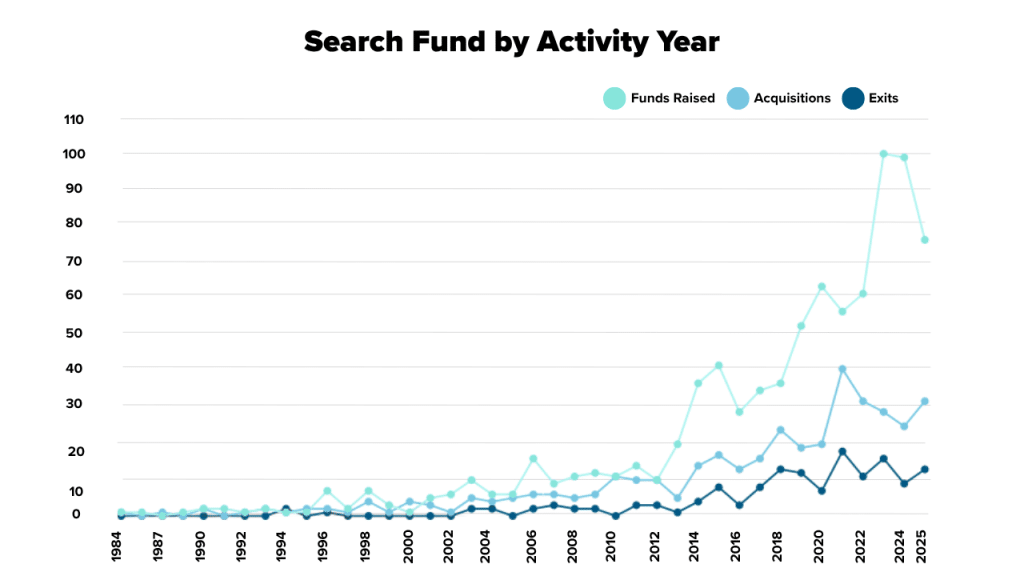
What the Winners Do Differently
The study also identified several traits shared by searchers who successfully acquired companies.
One of the strongest indicators was speed. Searchers who signed an LOI within their first six months acquired a company at a 74% rate, compared to 48% across the broader cohort. Those who signed an LOI within their first year acquired at a 65% rate. Stanford’s findings reinforce why Calder Capital places so much emphasis on early deal flow. Our buy-side engagements include a six-month initial term and lead guarantees because our goal is not simply to create introductions. We want buyers actively evaluating opportunities and progressing toward an LOI within the first six months of their search. As Stanford’s data suggests, buyers who generate momentum early are significantly more likely to complete an acquisition.
Experience of the searcher is a key factor to success. Searchers with more than two years of post-graduation experience acquired companies at a 55% rate, compared to 40% for those with one year or less of experience.
Partnered search funds, search funds led by two searchers rather than a single entrepreneur, continued to outperform solo searchers in several key areas. Search funds launched between 2021 and 2024 that were led by partners achieved a 58% acquisition rate, compared to 43% for solo searchers.
Stanford concluded that “experience, partnership dynamics, and early traction remain important factors in acquiring a company.”
At Calder Capital, we see those themes play out in three practical ways:
- Preparation: Successful buyers typically enter the market with a clearly defined acquisition strategy, realistic valuation expectations, and a compelling story for business owners. Before outreach begins, Calder helps clients refine their buy box, develop marketing materials such as a personal video, and clearly articulate why they are the right long-term successor for a business.
- Early momentum: We begin outreach shortly after engagement, distribute acquisition mandates across our network of 375k+ people, and launch direct owner outreach campaigns designed to generate meaningful deal flow quickly. Our six-month initial term and lead guarantee are built around creating this early momentum.
- Disciplined execution: Finding opportunities is only part of the challenge. Buyers must also manage diligence, valuation negotiations, financing hurdles, and changing circumstances throughout the transaction process. Calder’s buy-side team helps clients prioritize opportunities, navigate diligence findings, and work through valuation gaps that might otherwise derail a promising acquisition.
The searchers who succeed are not only reviewing the most deals, but they’re also evaluating opportunities properly and moving decisively with sufficient capital backing when the right company emerges.
Gaining a Competitive Edge Over Other Buyers
One of the more interesting conclusions from Stanford’s study is that acquisition success increasingly depends on factors that can be difficult for first-time buyers to develop quickly: generating proprietary deal flow, evaluating opportunities effectively, and navigating transactions from LOI to closing. These are also many of the same challenges that cause searches and deals to stall.
This is where experienced buy-side advisors can create significant value. Calder Capital’s Buy-Side team helps searchers identify off-market opportunities, evaluate acquisition targets, navigate diligence findings, and maintain momentum throughout the transaction process. In a market where quality businesses often attract multiple interested buyers, these advantages can meaningfully improve a buyer’s odds of reaching a successful closing.
The broader takeaway from Stanford’s 2026 Search Fund Study is clear: entrepreneurship through acquisition is becoming more competitive, and acquisition success increasingly comes down to preparation, proprietary deal flow, and disciplined execution. Buyers who generate opportunities early, identify risks before they become problems, and maintain momentum throughout diligence put themselves in the strongest position to succeed.
If you’re actively searching for a business to acquire, connect with Calder Capital’s Buy-Side team to help you identify opportunities, evaluate targets, and navigate the path from search to closing.
About Calder Capital:
Founded in 2013, Calder Capital is a cross-industry mergers and acquisitions advisory firm with offices across the United States. Calder provides valuation, sell-side, and buy-side services. We are nationally recognized for excellence in advising $1-100M enterprise value transactions in manufacturing, construction, distribution, and business services. Calder serves business owners, entrepreneurs, family offices, financial buyers, and investors. Learn more at www.CalderGR.com.
Notice: Calder Capital, LLC is not affiliated with any similarly named organizations or entities. To verify communications from our firm, visit our website or contact [email protected].